
The Uncharted Frontier: How AI and Augmented Reality Are Crafting the Future of Flexible Learning Paths
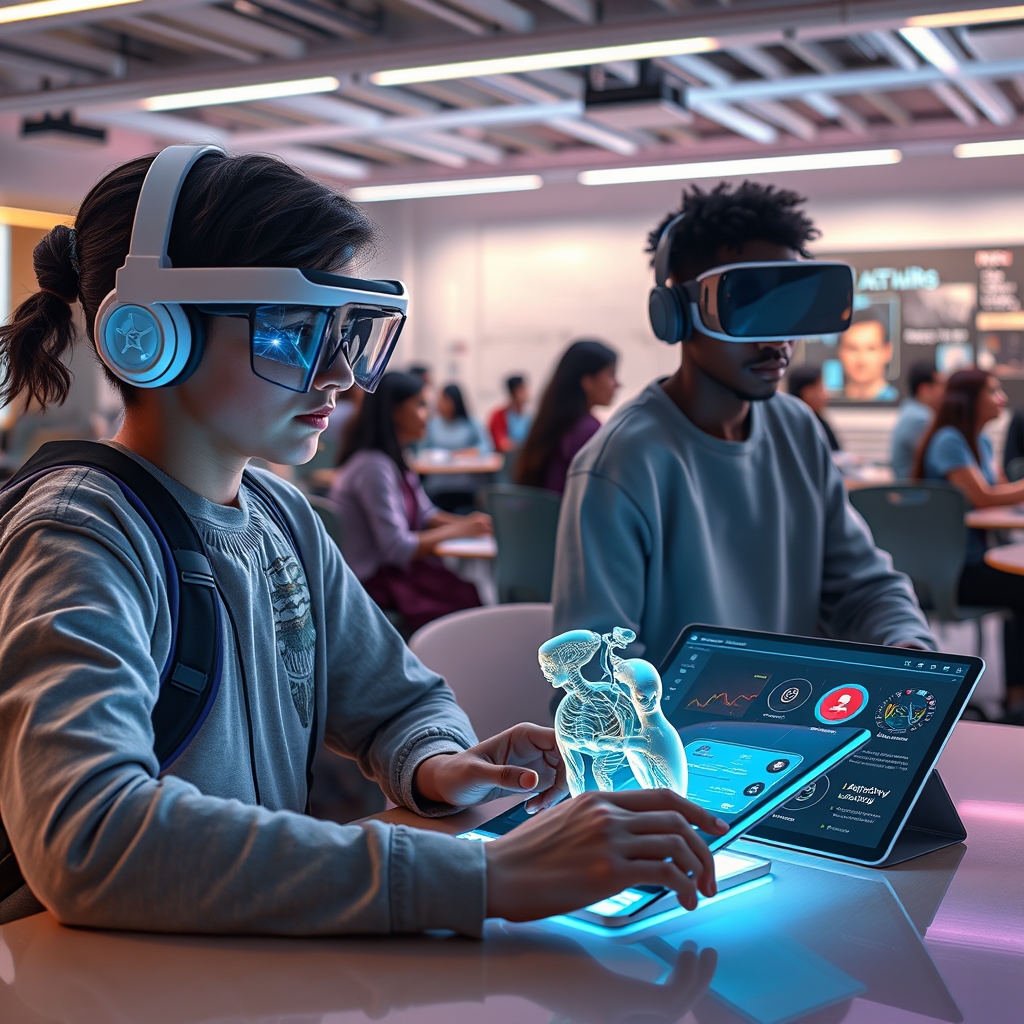
Imagine a world where education bends to the rhythm of your life, not the other way around. A world where learning is not confined to the four walls of a classroom or the rigid structure of a syllabus, but instead flows seamlessly into your daily routine, adapting to your pace, your interests, and your unique needs. This is not a distant dream—it is the reality being shaped by the convergence of artificial intelligence (AI) and augmented reality (AR), two technologies that are redefining the very essence of flexible learning paths.
The Evolution of Learning: From Static to Dynamic
Traditional education systems have long operated on a one-size-fits-all model, where students are expected to conform to a predetermined curriculum, often at a pace that may not suit their individual learning styles. This approach, while efficient in some respects, leaves little room for personalization or adaptability. Enter AI-powered learning systems, which are transforming education from a static, linear process into a dynamic, fluid experience. These systems analyze vast amounts of data—from a learner’s performance and engagement levels to their preferences and goals—to create a tailored educational journey. The result? A learning experience that evolves in real-time, ensuring that each student receives the right content, at the right time, in the right format.
The Role of Augmented Reality in Crafting Immersive Experiences
While AI lays the foundation for personalization, augmented reality adds a layer of immersion that was previously unimaginable. AR bridges the gap between the digital and physical worlds, allowing learners to interact with content in ways that are both engaging and intuitive. For example, medical students can use AR to visualize complex anatomical structures in 3D, overlaying digital information onto their physical surroundings. Similarly, history students can walk through ancient civilizations, exploring historical sites as if they were there in person. This level of immersion not only enhances understanding but also makes learning more memorable and enjoyable.
AR also plays a crucial role in breaking down the barriers of traditional learning environments. No longer are students limited to textbooks or two-dimensional screens. Instead, they can manipulate objects, conduct virtual experiments, and collaborate with peers in shared augmented spaces. This shift from passive to active learning is a game-changer, particularly for subjects that require hands-on experience or spatial understanding. By integrating AR into flexible learning paths, educators can create experiences that are not only informative but also deeply engaging.
The Power of Micro-Credentials and Digital Badges
As learning becomes more personalized and flexible, the way we recognize and validate knowledge is also evolving. Traditional degrees and certifications, while still valuable, are no longer the only markers of expertise. Enter micro-credentials and digital badges—small, stackable certifications that validate specific skills or competencies. These credentials are particularly well-suited to the modern learner, who may not have the time or resources to commit to a full degree program but still wants to acquire and demonstrate new skills.
AI-powered platforms are making it easier than ever to earn and showcase these micro-credentials. For instance, adaptive learning software can identify gaps in a learner’s knowledge and recommend targeted courses or modules to fill those gaps. Once completed, the learner receives a digital badge that can be shared on professional networks like LinkedIn or added to a digital portfolio. This not only provides tangible proof of skills but also empowers learners to take control of their professional development. In a world where the half-life of skills is shrinking, micro-credentials offer a way to stay relevant and competitive in the job market.
Hybrid Learning Models: The Best of Both Worlds
The rise of flexible learning paths has also given birth to hybrid learning models, which blend the best elements of online and in-person education. These models leverage AI and AR to create a seamless learning experience that can be accessed anytime, anywhere. For example, a student might attend a virtual lecture via an AR-enabled platform, complete interactive assignments online, and then participate in a hands-on workshop in a physical classroom. This hybrid approach not only accommodates different learning styles but also makes education more accessible to those who may not have the flexibility to attend traditional classes.
Hybrid learning models are particularly effective in corporate training, where employees often need to balance learning with their professional responsibilities. AI-powered platforms can deliver personalized training modules that employees can complete at their own pace, while AR can be used to simulate real-world scenarios, such as customer interactions or equipment handling. This combination of flexibility and practicality makes hybrid learning an ideal solution for modern workplaces.
The Future of Learning: A Lifelong Journey
The convergence of AI, AR, and flexible learning paths is not just transforming education—it is redefining what it means to learn. In this new paradigm, learning is no longer a finite process that ends with a degree or certification. Instead, it is a lifelong journey, one that adapts and evolves alongside the learner. Whether you are a student, a professional, or simply someone with a thirst for knowledge, these technologies are making it possible to learn in ways that are more personalized, immersive, and flexible than ever before.
As we stand on the brink of this educational revolution, one thing is clear: the future of learning is not about replacing traditional methods but enhancing them. It is about creating a world where education is not a privilege reserved for the few but a dynamic, accessible, and empowering experience for all. The tools and technologies are already here—it is up to us to embrace them and unlock the full potential of flexible learning paths.



