
The AI-Powered Classroom: How Adaptive Software and Virtual Reality Are Crafting the Future of Education
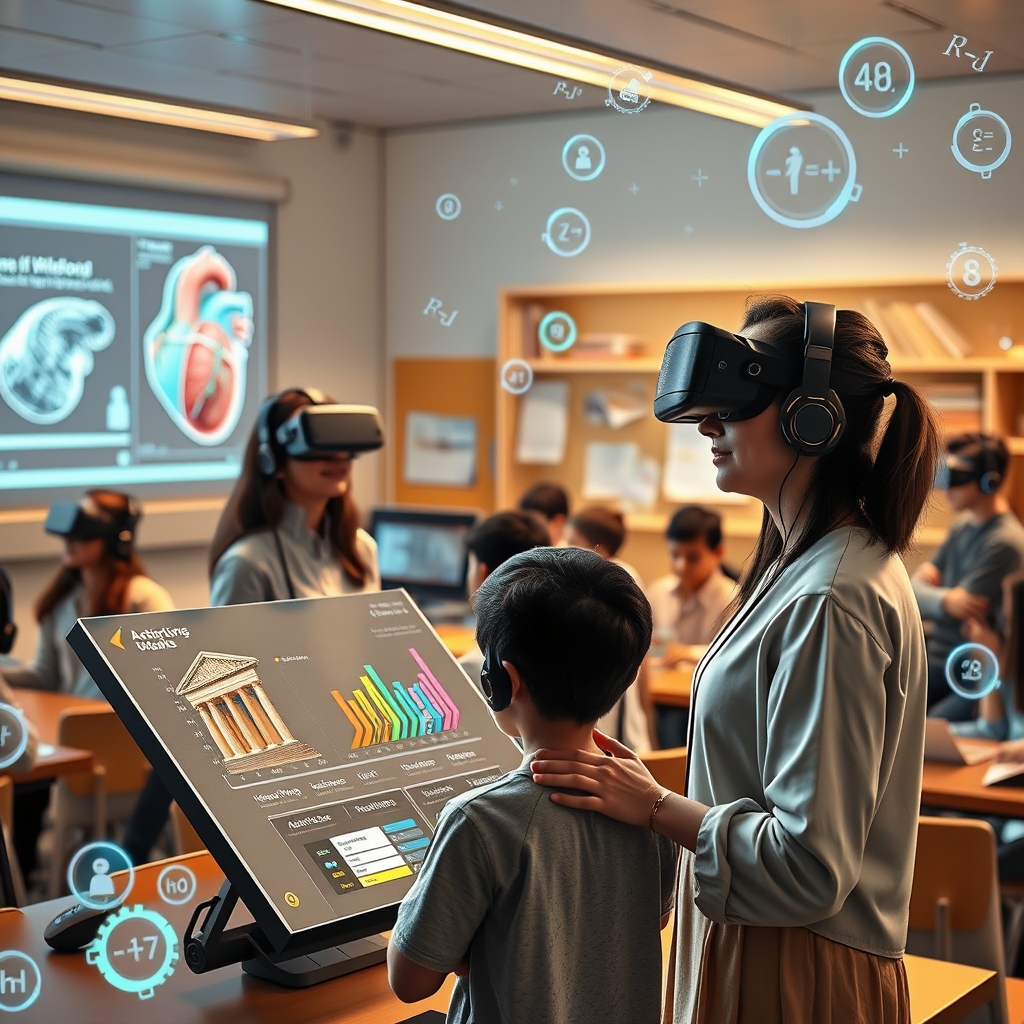
The traditional classroom, with its rows of desks and one-size-fits-all lessons, is undergoing a profound transformation. As technology continues to evolve, so too does the way we learn. At the heart of this revolution are adaptive teaching software and virtual reality classrooms, two innovations that are redefining education by making it more personalized, engaging, and effective than ever before. These tools are not just enhancing learning—they are fundamentally reshaping it, creating experiences that adapt to the needs of each student rather than forcing students to adapt to a rigid system.
The Rise of Adaptive Teaching Software
Adaptive teaching software leverages artificial intelligence to create dynamic learning experiences tailored to the individual. Unlike traditional methods, which often rely on a linear curriculum, adaptive software continuously assesses a student’s performance, identifying strengths and weaknesses in real time. This allows the system to adjust the difficulty of tasks, provide targeted feedback, and even suggest supplementary resources to address knowledge gaps. For example, a student struggling with algebraic concepts might receive additional practice problems and explanatory videos, while a peer who has mastered the topic could be challenged with more advanced material.
The power of adaptive software lies in its ability to meet learners where they are. Whether in K-12 education, higher education, or corporate training online, these systems ensure that no student is left behind or held back by a pace that doesn’t suit them. Research has shown that adaptive learning can significantly improve outcomes, particularly for students who may have previously struggled in traditional settings. By providing a flexible learning path, adaptive software empowers learners to take ownership of their education, fostering a sense of autonomy and confidence that is often missing in conventional classrooms.
Immersive Learning Through Virtual Reality
While adaptive software personalizes the learning experience, virtual reality classrooms take engagement to an entirely new level. VR technology transports students beyond the confines of their physical environment, allowing them to explore historical events, conduct virtual science experiments, or even practice surgical procedures in a risk-free setting. Imagine a history lesson where students can walk through ancient Rome, witnessing the construction of the Colosseum firsthand, or a biology class where they can shrink down to the size of a cell and observe cellular processes up close. These experiences are not just memorable—they are transformative.
Virtual reality also addresses one of the biggest challenges in education: maintaining student engagement. Traditional lectures and textbooks often fail to capture the attention of digital-native learners, but VR’s immersive nature makes learning feel like an adventure rather than a chore. This is particularly valuable in subjects that are inherently abstract or difficult to visualize, such as physics or chemistry. By making the invisible visible, VR bridges the gap between theory and practice, helping students grasp complex concepts with greater ease.
The Synergy of AI and VR in Education
The true potential of these technologies is unlocked when they are combined. Adaptive software can track a student’s progress within a VR environment, adjusting the difficulty of tasks or providing real-time hints and feedback. For instance, a student navigating a virtual chemistry lab might receive guidance from an AI-powered virtual tutor if they struggle with a particular step in an experiment. This synergy creates a learning experience that is not only immersive but also deeply personalized, catering to the unique needs of each learner.
Moreover, the integration of AI and VR is paving the way for hybrid learning models that blend the best of in-person and digital education. Schools and universities can use VR to create collaborative learning spaces where students from different locations can work together on projects, while adaptive software ensures that each participant receives the support they need. This approach is particularly valuable in an era where remote and hybrid learning have become increasingly common, offering a way to maintain the social and interactive aspects of education even when students are physically apart.
The Future of Credentials and Skill Validation
As education becomes more personalized and technology-driven, the way we validate skills and knowledge is also evolving. Traditional degrees and certificates are no longer the only markers of expertise. Instead, micro-credentials and digital badges are gaining traction as a way to recognize specific skills and competencies. These credentials are often earned through short, focused microlearning courses, which allow learners to acquire new skills quickly and efficiently. For example, a professional looking to upskill in data analysis might complete a series of micro-courses on Python programming, each culminating in a digital badge that can be displayed on LinkedIn or a personal portfolio.
The rise of micro-credentials reflects a broader shift toward skill-based certifications that prioritize practical, job-ready abilities over theoretical knowledge. This trend is particularly relevant in the corporate world, where employers are increasingly looking for candidates who can demonstrate proficiency in specific tools or methodologies. Adaptive software and VR can play a crucial role in this ecosystem by providing the hands-on, experiential learning that micro-credentials often require. For instance, a VR simulation could allow a learner to practice project management techniques in a realistic setting, earning a badge upon successful completion.
Challenges and Considerations
While the potential of adaptive software and VR in education is immense, their widespread adoption is not without challenges. One of the biggest hurdles is accessibility. High-quality VR equipment can be expensive, and not all schools or learners have the resources to invest in it. Similarly, adaptive software often requires robust infrastructure and technical support, which may be lacking in underfunded educational institutions. To ensure that these technologies benefit all learners, it is essential to address these disparities and explore cost-effective solutions, such as mobile-based VR or cloud-based adaptive learning platforms.
Another consideration is the need for teacher training. While AI and VR can enhance learning, they are not a replacement for skilled educators. Teachers must be equipped with the knowledge and tools to integrate these technologies into their classrooms effectively. This includes understanding how to use adaptive software to complement their teaching strategies and how to design VR-based lessons that align with curriculum goals. Professional development programs and ongoing support will be key to ensuring that educators can leverage these tools to their full potential.
As we look to the future, it is clear that the classroom of tomorrow will be a far cry from the one we know today. Adaptive teaching software and virtual reality are not just incremental improvements—they represent a fundamental shift in how we approach education. By making learning more personalized, engaging, and accessible, these technologies have the power to unlock the potential of every student, regardless of their background or learning style. The question is no longer whether these innovations will shape the future of education, but how quickly we can embrace them to create a world where learning knows no bounds. The tools are here; it is up to us to use them wisely and ensure that no learner is left behind in this exciting new era.



