
Beyond the Screen: How Augmented Reality and Gamification Are Crafting Immersive Learning Experiences
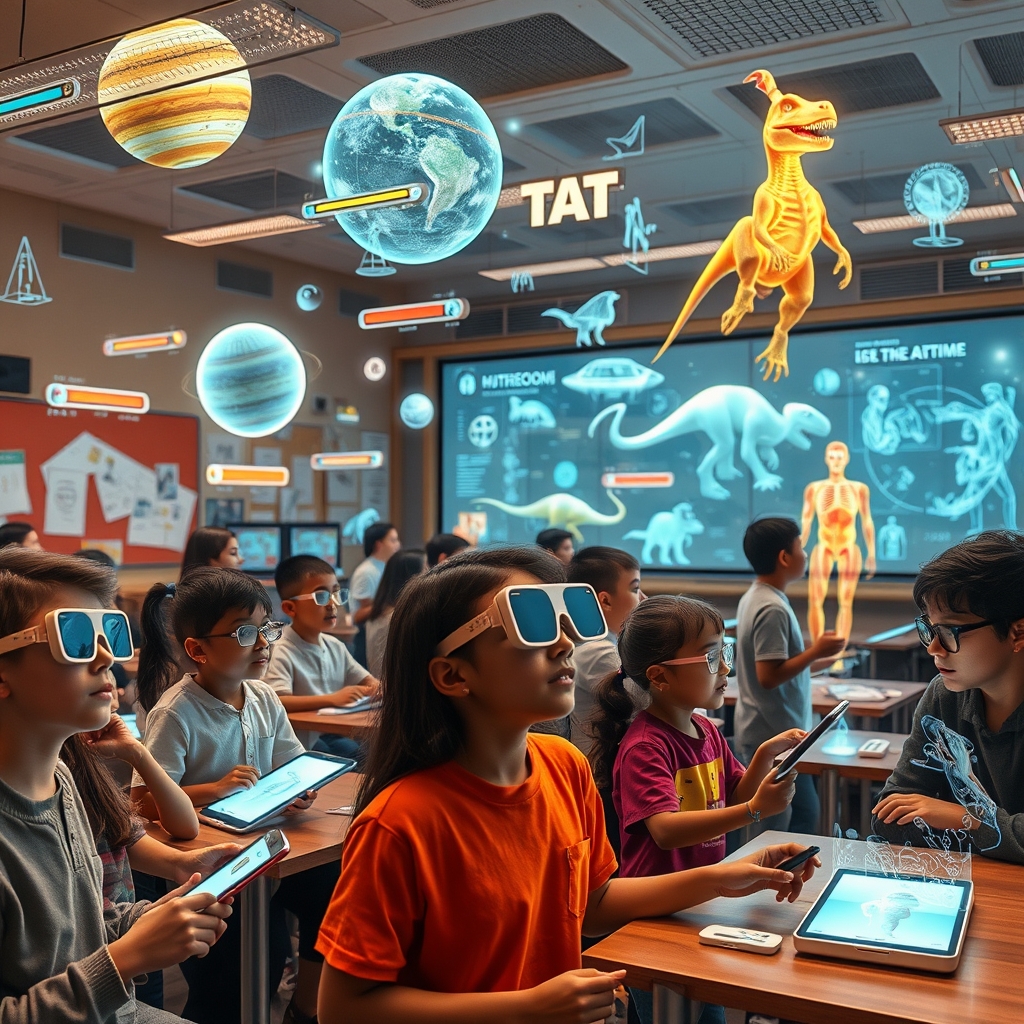
Imagine a classroom where history lessons unfold before your eyes, where ancient civilizations rise from the pages of a textbook, and where students can walk through the streets of Rome as if they were there. This is not a scene from a science fiction movie but a glimpse into the future of education, where Augmented Reality (AR) and gamification are transforming how we learn. These technologies are not just enhancing education; they are redefining it, making learning an immersive, interactive, and deeply engaging experience.
The Rise of Augmented Reality in Education
Augmented Reality bridges the gap between the digital and physical worlds, overlaying virtual elements onto our real environment. In education, AR has the power to turn abstract concepts into tangible experiences. For instance, medical students can use AR to visualize the human body in 3D, exploring organs and systems with unprecedented clarity. Similarly, engineering students can manipulate virtual prototypes, testing designs in a risk-free environment before bringing them to life.
One of the most compelling applications of AR is in interactive ebooks. These digital textbooks come alive with animations, quizzes, and simulations, allowing students to interact with content in ways that traditional books never could. A biology student, for example, can dissect a virtual frog or observe cellular processes in real-time, deepening their understanding through hands-on exploration. AR is not just a tool; it is a gateway to a more dynamic and engaging form of learning.
Gamification: Turning Learning into Play
Gamification leverages the principles of game design to make learning more engaging and motivating. By incorporating elements like points, badges, leaderboards, and challenges, educators can transform mundane tasks into exciting quests. This approach taps into the natural human desire for achievement and competition, making students more likely to stay engaged and retain information.
Consider a language learning app that rewards users with digital badges for completing lessons or mastering new vocabulary. These badges serve as tangible markers of progress, motivating learners to continue their journey. Similarly, corporate training programs use gamification to make compliance training or skill development more enjoyable. Employees earn points for completing modules, competing with colleagues on leaderboards, and unlocking rewards, turning what could be a tedious process into an engaging experience.
The Synergy of AR and Gamification
When AR and gamification are combined, the result is a learning experience that is both immersive and interactive. Imagine a history class where students use AR to explore a virtual battlefield, solving puzzles and completing challenges to unlock the next chapter of the story. Or a science class where students conduct virtual experiments, earning points for each successful outcome. These experiences make learning feel like an adventure, where curiosity is rewarded and knowledge is gained through exploration.
This synergy is particularly powerful in virtual reality classrooms, where students can collaborate in a shared digital space. Here, AR enhances the environment, while gamification drives engagement. For example, a group of students might work together to solve a complex math problem in a virtual escape room, using AR to visualize the problem and gamification to track their progress. The result is a collaborative, hands-on learning experience that feels more like play than work.
The Role of AI in Personalizing the Experience
Behind the scenes, AI-powered learning systems are working to personalize these experiences, adapting content to meet the unique needs of each learner. AI can analyze a student’s performance, identifying strengths and weaknesses, and adjusting the difficulty of challenges accordingly. This ensures that learners are neither bored nor overwhelmed, but consistently engaged at the right level.
For instance, an AI-driven adaptive teaching software might notice that a student struggles with a particular math concept. The system could then generate additional AR-based exercises tailored to that topic, using gamification to keep the student motivated. Over time, the AI refines its approach, creating a flexible learning path that evolves with the student’s progress. This level of personalization was once the stuff of dreams but is now becoming a reality in classrooms around the world.
The Future of Learning: Accessible, Engaging, and Lifelong
The integration of AR and gamification into education is not just about making learning more fun; it is about making it more accessible and effective. These technologies break down barriers, allowing students to learn at their own pace, in their own way. Whether through mobile learning apps that bring education to remote areas or microlearning courses that fit into busy schedules, AR and gamification are democratizing education.
Moreover, these innovations are fostering a culture of lifelong learning. In a world where skills quickly become outdated, the ability to continuously learn and adapt is more important than ever. AR and gamification make learning a lifelong pursuit, turning every challenge into an opportunity for growth. They transform education from a static, one-time event into a dynamic, ongoing journey.
As we look to the future, it is clear that the boundaries of the classroom are expanding. The traditional model of education—where students sit passively, absorbing information—is giving way to a new paradigm where learning is active, immersive, and deeply personal. Augmented Reality and gamification are at the forefront of this shift, crafting experiences that engage the mind, inspire curiosity, and prepare learners for the challenges of tomorrow. The question is no longer whether these technologies will shape the future of education, but how far they will take us on this exciting journey.



