
The Silent Architects of Tomorrow: How AI and Augmented Reality Are Crafting the Future of Skill-Based Learning Ecosystems
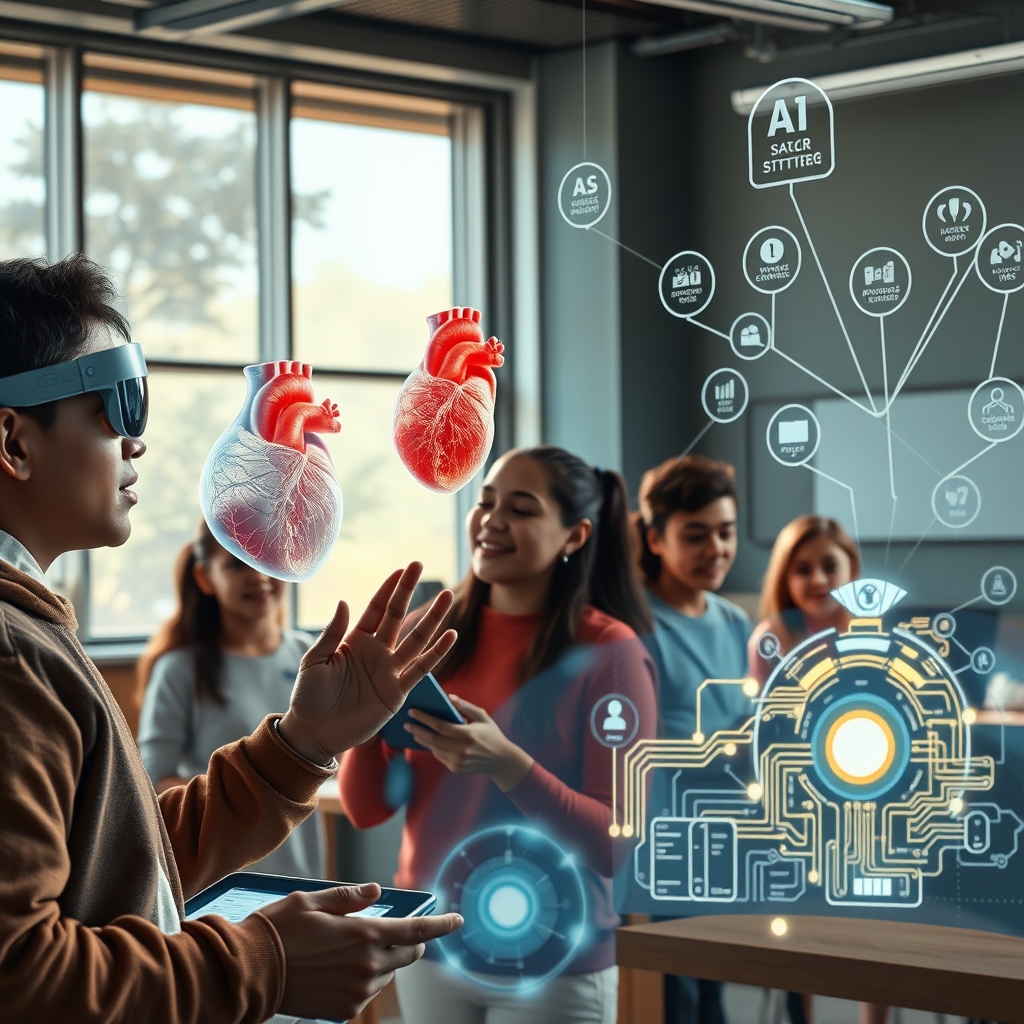
Imagine stepping into a classroom where the walls dissolve into a bustling ancient marketplace, where Socrates debates philosophy with students who are thousands of miles apart, yet standing side by side. This is not a scene from a science fiction novel but a glimpse into the future of education, where augmented reality (AR) and artificial intelligence (AI) are converging to create dynamic, skill-based learning ecosystems. These technologies are not just enhancing education; they are redefining it, turning passive learners into active participants in their own intellectual journeys.
The Rise of the Augmented Learner
Augmented reality has long been associated with gaming and entertainment, but its potential in education is nothing short of revolutionary. By overlaying digital information onto the physical world, AR transforms abstract concepts into tangible experiences. For instance, medical students can now dissect virtual cadavers, exploring the human body in three dimensions without the need for a physical specimen. Similarly, engineering students can manipulate 3D models of complex machinery, understanding their inner workings in a way that textbooks never could.
But AR is not just about visualization; it is about interaction. In a history class, students can walk through a virtual reconstruction of the Colosseum, witnessing gladiatorial combat as if they were there. In a biology lesson, they can shrink down to the size of a cell, navigating the intricate pathways of cellular processes. These immersive experiences make learning not just engaging but unforgettable, bridging the gap between theory and practice in ways that traditional education methods cannot.
The AI-Powered Personalization Engine
While AR brings the world into the classroom, AI ensures that the classroom adapts to the learner. Personalized learning systems powered by AI analyze a student’s strengths, weaknesses, and learning styles, tailoring content to meet their individual needs. This is not a one-size-fits-all approach but a dynamic, evolving process that grows with the learner. For example, an AI-driven platform might detect that a student struggles with algebraic equations but excels in geometry. It can then adjust the curriculum to provide more practice in algebra while offering advanced challenges in geometry, ensuring that the student remains both challenged and engaged.
AI also plays a crucial role in providing real-time feedback. Virtual tutors, powered by natural language processing and machine learning, can answer questions, explain concepts, and even engage in Socratic dialogue with students. These tutors are available 24/7, offering support whenever and wherever it is needed. This level of personalization and accessibility was unimaginable just a decade ago, yet today, it is becoming the standard in forward-thinking educational institutions.
The Synergy of AR and AI: A New Learning Paradigm
The true magic happens when AR and AI converge. Imagine a language learning app that uses AR to place virtual objects in the real world, labeling them in the target language. As the learner interacts with these objects, the AI assesses their pronunciation, grammar, and comprehension, providing instant feedback and adjusting the difficulty level in real time. Or consider a corporate training program where employees use AR to simulate real-world scenarios, such as handling a difficult customer or operating complex machinery. The AI analyzes their performance, offering personalized tips and strategies to improve their skills.
This synergy extends beyond individual learning. In collaborative settings, AR and AI can create shared virtual spaces where students from different parts of the world work together on projects, solving problems in real time. The AI can facilitate these interactions, ensuring that each student’s contributions are valued and that the group remains focused on their goals. This not only enhances learning outcomes but also fosters essential skills like teamwork, communication, and critical thinking.
The Future of Skill-Based Certifications
As the job market evolves, so too must the way we validate skills and knowledge. Traditional degrees and certifications are no longer sufficient to demonstrate proficiency in a rapidly changing world. Enter micro-credentials and digital badges, which offer a more flexible and granular way to showcase expertise. These credentials are often earned through short, focused courses that teach specific skills, such as coding in Python, project management, or data analysis. AI plays a pivotal role in this ecosystem, assessing learners’ performance and awarding badges based on demonstrated competencies rather than time spent in a classroom.
AR enhances this process by providing immersive, hands-on assessments. For example, a learner seeking a micro-credential in mechanical engineering might use an AR simulation to assemble and troubleshoot a virtual engine. The AI evaluates their performance, offering feedback and, if successful, awarding the digital badge. This approach ensures that credentials are not just pieces of paper but tangible proof of a learner’s abilities.
The Role of Gamification in Skill Mastery
Gamification, the application of game-design elements in non-game contexts, is another powerful tool in the modern educator’s arsenal. By incorporating elements like points, leaderboards, and challenges, gamification makes learning more engaging and motivating. AI enhances this by dynamically adjusting the difficulty of tasks to keep learners in a state of



