
The Learning Alchemy: How Augmented Reality and Micro-Credentials Are Forging the Future of Skill Mastery
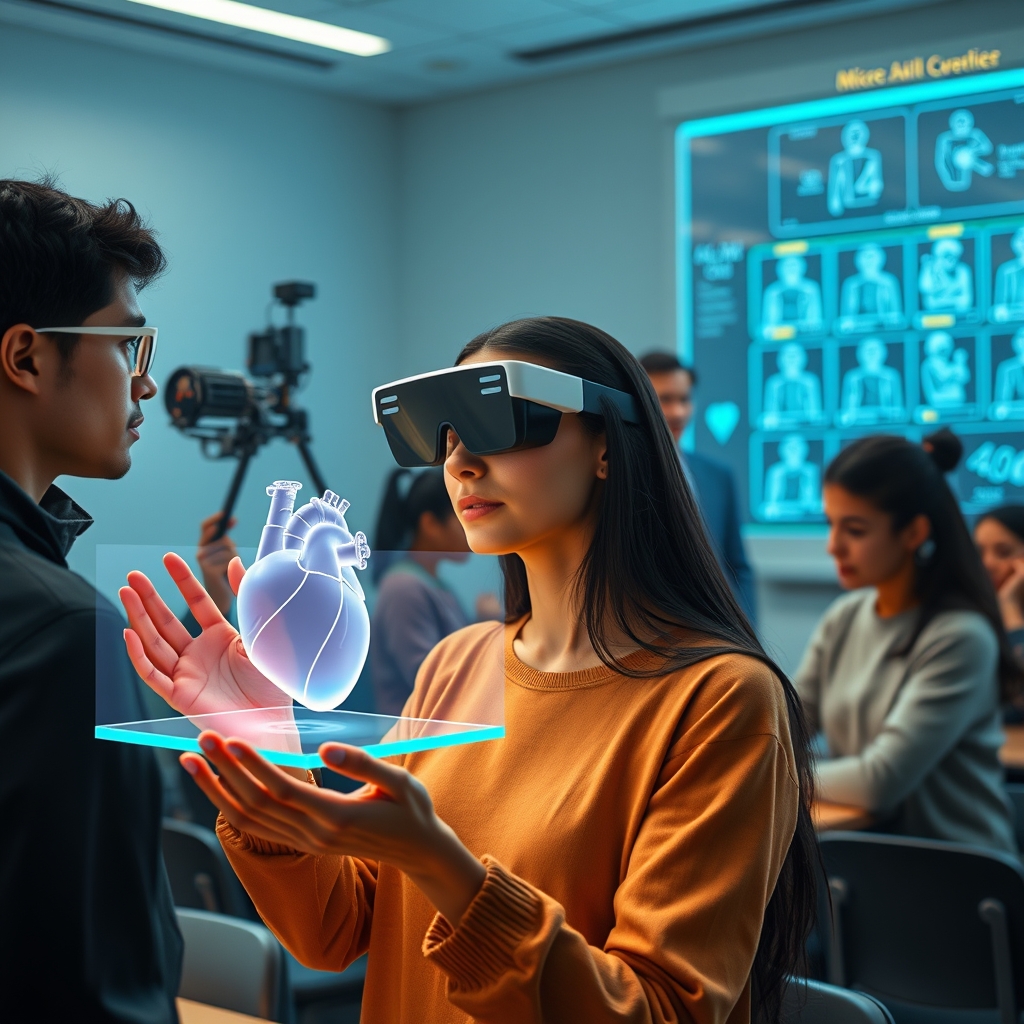
The digital transformation of education is not just a trend—it’s a fundamental shift in how we acquire, validate, and apply knowledge. At the heart of this evolution lies a powerful combination of augmented reality (AR) education and micro-credentials, two innovations that are redefining skill mastery in ways previously unimaginable. Together, they are dismantling the rigid structures of traditional learning, replacing them with dynamic, immersive, and highly personalized experiences that adapt to the needs of the modern learner.
The AR Revolution: Learning Beyond the Screen
Augmented reality is no longer confined to the realms of gaming or entertainment. In education, AR is emerging as a transformative tool that bridges the gap between theoretical knowledge and real-world application. Imagine a medical student practicing surgical techniques on a holographic patient, or an engineering apprentice assembling a virtual engine in mid-air, manipulating components with their hands. These are not scenes from a sci-fi movie—they are the new realities of AR education.
Unlike virtual reality, which immerses users in a fully digital environment, AR overlays digital information onto the physical world. This makes it an ideal medium for hands-on learning, where context and environment play a crucial role. For instance, architecture students can walk through a 3D model of their design superimposed on an empty lot, while history students can explore ancient civilizations by pointing their devices at a textbook. The result? A deeper, more intuitive understanding of complex concepts, where learning is not just observed but experienced.
The Power of Immediate Feedback
One of the most compelling advantages of AR in education is its ability to provide instant feedback. Traditional learning often relies on delayed assessments—quizzes, exams, or assignments graded days or weeks later. AR, however, can correct mistakes in real-time, guiding learners through each step of a process. A chemistry student mixing virtual compounds, for example, can receive immediate alerts if they combine the wrong elements, along with explanations of the correct procedure. This iterative learning process accelerates mastery and builds confidence, as students learn not just from success, but from their mistakes.
Micro-Credentials: The Currency of Modern Skill Mastery
While AR is revolutionizing how we learn, micro-credentials are transforming how we validate what we’ve learned. In a world where skills become outdated faster than degrees can be earned, traditional education models are struggling to keep pace. Micro-credentials—small, stackable certifications that validate specific competencies—offer a flexible, agile alternative. They allow learners to demonstrate proficiency in niche skills, from coding in Python to project management, without committing to a full degree program.
Platforms like Coursera, edX, and LinkedIn Learning have already embraced micro-credentials, offering digital badges that can be displayed on resumes, LinkedIn profiles, or professional portfolios. These badges serve as tangible proof of expertise, making them invaluable for career advancement. For employers, micro-credentials provide a clear, granular view of a candidate’s capabilities, reducing the guesswork in hiring decisions. For learners, they offer a pathway to continuous upskilling, ensuring their knowledge remains relevant in an ever-changing job market.
The Stackable Future of Learning
The true power of micro-credentials lies in their stackability. Unlike traditional degrees, which are often monolithic and inflexible, micro-credentials can be combined in countless ways to create personalized learning pathways. A marketer, for instance, might earn badges in data analytics, content strategy, and SEO, stacking them to build a unique skill set tailored to their career goals. This modular approach to education aligns perfectly with the demands of the gig economy, where versatility and adaptability are key.
Moreover, micro-credentials are democratizing education. They lower the barriers to entry, making high-quality learning accessible to those who may not have the time or resources to pursue a full degree. Whether it’s a single mother upskilling between shifts or a mid-career professional pivoting to a new industry, micro-credentials provide a lifeline to opportunity.
The Synergy of AR and Micro-Credentials
When augmented reality and micro-credentials converge, the result is a learning ecosystem that is as immersive as it is practical. AR provides the experiential foundation for skill acquisition, while micro-credentials offer the validation needed to translate those skills into career advancement. Together, they create a feedback loop where learning is continuous, engaging, and directly tied to real-world outcomes.
Consider a scenario where a technician earns a micro-credential in drone repair. Using AR, they practice dismantling and reassembling a virtual drone, receiving real-time guidance and corrections. Once they’ve mastered the skill, they take an assessment—perhaps a timed challenge where they diagnose and fix a simulated malfunction. Upon completion, they earn a digital badge, which they can share with employers or clients as proof of their expertise. This seamless integration of learning and validation is the future of skill mastery.
Corporate Training Reimagined
The corporate world is already taking note. Companies are leveraging AR and micro-credentials to revolutionize corporate training online, moving away from one-size-fits-all workshops to personalized, on-demand learning experiences. New hires can use AR simulations to familiarize themselves with company processes, while existing employees can earn micro-credentials in emerging technologies like AI or blockchain. This not only enhances productivity but also fosters a culture of continuous learning, where employees are empowered to take ownership of their professional development.
For industries with high-stakes environments—such as healthcare, aviation, or manufacturing—AR training can simulate rare or dangerous scenarios without putting lives or equipment at risk. A surgeon, for example, can practice a complex procedure on a virtual patient, earning a micro-credential upon successful completion. This blend of immersive practice and formal validation ensures that skills are not just learned but internalized.
The Road Ahead: A Learning Ecosystem Without Limits
The fusion of augmented reality and micro-credentials is just the beginning. As edtech innovations continue to evolve, we can expect even more seamless integrations of technology and learning. Imagine a future where AR glasses become as common as smartphones, providing real-time tutoring and skill validation in any environment. Or where micro-credentials are automatically updated as new technologies emerge, ensuring that learners remain at the cutting edge of their fields.
This future is not distant—it’s being built today. Educational institutions, corporations, and learners themselves are embracing these tools, recognizing that the key to success in the 21st century lies not in static knowledge, but in the ability to adapt, upskill, and master new competencies at speed. The learning alchemy of AR and micro-credentials is not just transforming education; it’s forging a new paradigm where skill mastery is accessible, engaging, and endlessly adaptable. The question is no longer whether we can keep up with the pace of change, but how quickly we can harness these innovations to unlock our full potential.



