
The Digital Renaissance: How AI, AR, and Micro-Credentials Are Redefining Skill Mastery in the 21st Century
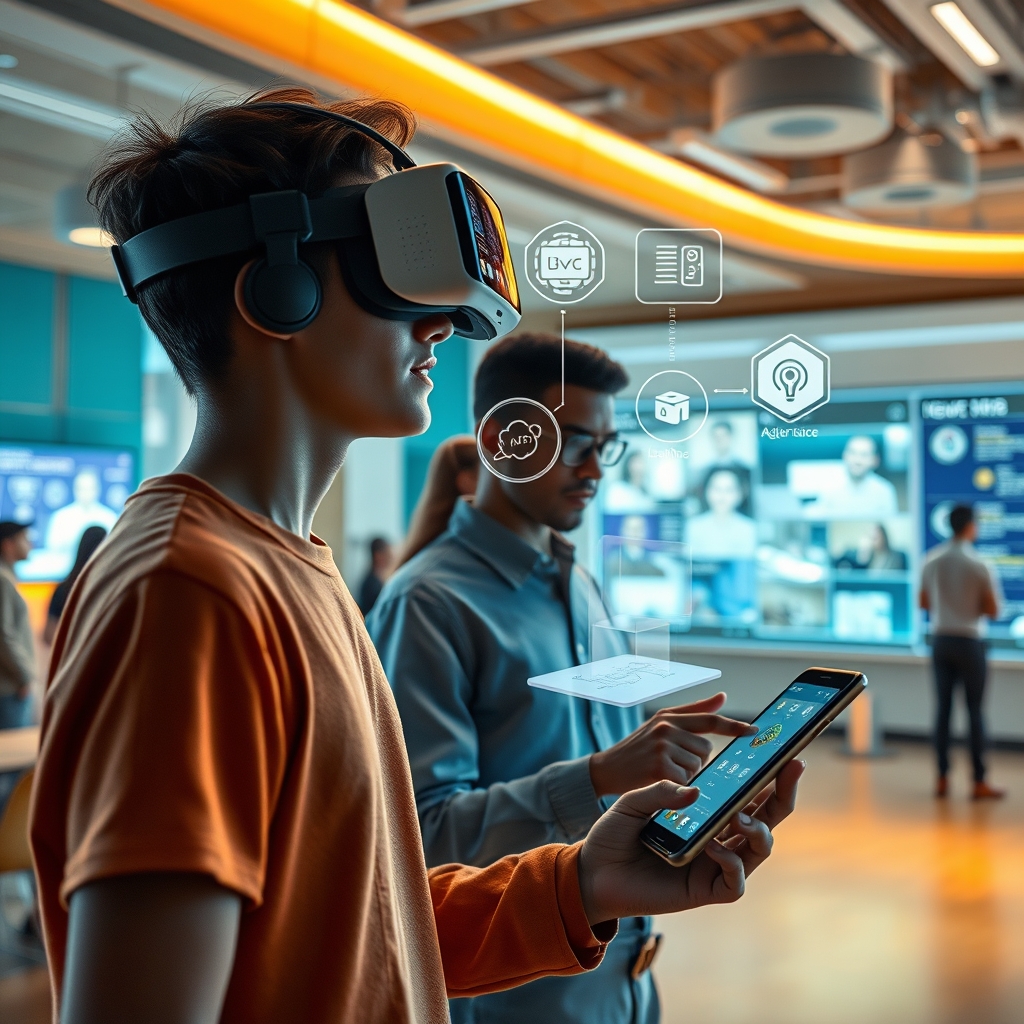
The landscape of education and professional development is undergoing a seismic shift, driven by technological advancements that were once the stuff of science fiction. Today, the fusion of AI-powered learning, augmented reality education, and micro-credentials is not just enhancing how we acquire knowledge—it’s fundamentally transforming the very nature of skill mastery. This digital renaissance is democratizing education, making it more accessible, personalized, and aligned with the demands of a rapidly evolving global economy.
The Rise of Adaptive Intelligence in Learning
At the heart of this transformation is adaptive teaching software, a game-changer in personalized education. Unlike traditional one-size-fits-all approaches, adaptive systems leverage artificial intelligence to analyze a learner’s strengths, weaknesses, and preferences in real time. These platforms, such as Duolingo’s language-learning algorithms or Khan Academy’s math tutors, dynamically adjust content difficulty, pacing, and even teaching methods to suit individual needs. The result? A learning experience that feels tailor-made, significantly boosting engagement and retention rates.
For instance, a student struggling with algebraic concepts might receive additional interactive exercises, while another excelling in geometry could be challenged with advanced problem-solving scenarios. This level of customization was unimaginable a decade ago but is now a cornerstone of modern personalized learning systems. The implications extend beyond K-12 education; corporate training programs are increasingly adopting adaptive software to upskill employees efficiently, ensuring that learning interventions are both targeted and impactful.
Immersive Technologies: Bridging the Gap Between Theory and Practice
While AI refines the personalization of learning, virtual reality classrooms and augmented reality education are revolutionizing how we interact with knowledge. These immersive technologies are dissolving the boundaries between theoretical learning and real-world application, creating environments where learners can practice skills in risk-free, hyper-realistic settings.
Imagine a medical student performing a virtual surgery, complete with haptic feedback to simulate the resistance of human tissue, or an engineering trainee assembling a complex machine in a 3D workspace. These scenarios are no longer confined to the realm of imagination. Platforms like Labster and zSpace are already offering VR labs for STEM education, while companies like Microsoft’s HoloLens are bringing AR into vocational training, allowing workers to overlay digital instructions onto physical tasks. The impact is profound: studies show that immersive learning can improve retention rates by up to 75% compared to traditional methods, as it engages multiple senses and fosters experiential learning.
The Gamification of Learning: Turning Education into an Adventure
Another pivotal innovation in this digital renaissance is the gamification of learning, which harnesses the motivational power of game design to make education more engaging. By incorporating elements like points, leaderboards, badges, and narrative-driven challenges, gamified learning platforms transform mundane tasks into compelling experiences. This approach is particularly effective in maintaining learner motivation, a critical factor in long-term skill development.
Take, for example, the language-learning app Memrise, which uses spaced repetition and gamified quizzes to help users retain vocabulary. Similarly, corporate training programs like those offered by Axonify use gamification to reinforce compliance training, turning what could be a tedious process into an interactive and competitive experience. The success of these platforms lies in their ability to tap into intrinsic motivators—curiosity, achievement, and social recognition—making learning feel less like a chore and more like a rewarding journey.
Micro-Credentials and Digital Badges: The New Currency of Competence
As the nature of work evolves, so too does the way we validate skills. Traditional degrees and certifications, while still valuable, are no longer the sole indicators of competence. Enter micro-credentials and digital badges, which offer a more granular and flexible way to showcase expertise. These bite-sized certifications focus on specific skills or knowledge areas, allowing learners to build a portfolio of competencies that are directly relevant to their career goals.
Platforms like Coursera, Udacity, and edX have pioneered this model, offering micro-credentials in fields ranging from data science to digital marketing. Employers are increasingly recognizing the value of these credentials, as they provide a clear and verifiable record of a candidate’s abilities. For professionals, this means the ability to upskill or reskill quickly, without the time and financial commitment of a full degree program. It’s a win-win: learners gain relevant skills, and employers gain access to a more agile and competent workforce.
The Future of Learning: Flexibility, Accessibility, and Lifelong Growth
The convergence of these technologies is giving rise to hybrid learning models and flexible learning paths, which blend online and offline experiences to create a seamless, learner-centric ecosystem. Whether through mobile learning apps that allow education on the go or microlearning courses that deliver content in digestible chunks, the emphasis is on meeting learners where they are—both literally and figuratively.
This shift is particularly empowering for lifelong learners, who can now pursue education at any stage of their careers. Lifelong learning programs are no longer a luxury but a necessity in a world where skills can become obsolete in a matter of years. The digital renaissance is making it possible for anyone, anywhere, to access high-quality education, breaking down barriers of geography, socioeconomic status, and time constraints.
As we stand on the brink of this new era, it’s clear that the future of learning is not just about technology—it’s about reimagining what education can be. The tools at our disposal are powerful, but their true potential lies in how we use them to foster curiosity, creativity, and a lifelong love of learning. The digital renaissance is not just changing how we learn; it’s redefining what it means to grow, adapt, and thrive in an ever-changing world. The question is no longer whether we can keep up with the pace of change, but how we can harness these innovations to create a future where learning is limitless, inclusive, and deeply human.



